How to take flash photos with a film look
The bright, head-on flash of a disposable camera is one of the most copied looks around. It makes faces pop, freezes the moment and drops the background into darkness. Here's why it works, and how to get it from a phone without it looking like a mistake.
By the DisCam team ·


Why direct flash looks like film
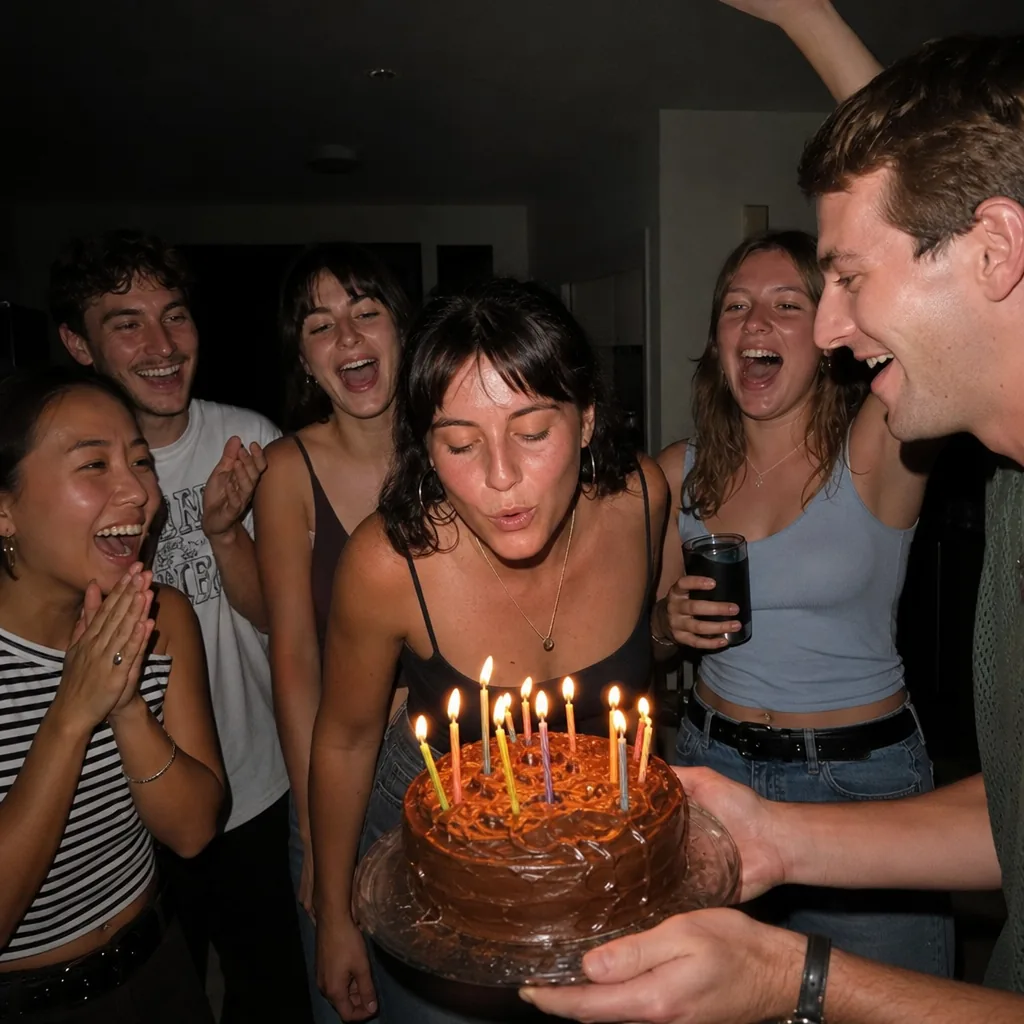
Cheap film cameras have a small flash right beside the lens, pointing straight ahead. It lights faces brightly and evenly, leaves a crisp shadow behind people, and fades fast with distance, so anything far away drops into darkness.
Phones usually avoid all that. In the dark they combine several exposures to brighten the whole scene, which gives smooth, even night photos. Flash does the opposite: one sharp instant, lit from the front. That's why it reads as a snapshot.
Turn it on sooner than you think
Flash isn't only for pitch darkness. Restaurants, bars, living rooms in the evening and the last light after sunset are all dim enough for flash to make a difference.
It also works in daylight. When the sun is behind someone, a flash fills in the shadows on their face. Film photographers call this fill flash, and it gives summer photos that bright, slightly unreal look.
Stand at the right distance
A phone or disposable flash only reaches a few metres. From about arm's length to a couple of metres away, faces are lit well and the background still shows a little.
Any closer and skin can burn out to white. Much further and the flash barely reaches, so the photo turns dark and grainy. If you're photographing a group, step back until everyone is about the same distance from you.
Watch what's behind
Mirrors, windows and glossy walls bounce the flash straight back as a white blob. Stand at a slight angle to them instead of facing them head-on.
A wall close behind people catches a hard shadow, which is part of the look. If you don't want it, ask them to step forward. A background far away goes dark, which is great for hiding a messy room.
Red eye, and how to avoid it
Red eye happens when the flash lights up the back of the eye. It's worst in dark rooms, where pupils are wide open, and when people look straight at the lens.
Turn up the room lights if you can, or catch people looking slightly away from the camera. Candid moments, mid-laugh or mid-conversation, also look more natural than everyone staring into the flash.
Choose a film that likes flash
Flash light is cool and white, so a film's colour makes a big difference. In DisCam, Flash ’99 is made for it, with punchy colour and the contrast of an old party photo. Warm 35 warms up the cold flash, and black and white turns flash photos into something graphic and timeless.
Flash ’99
Warm 35
Noir
Mono 400
Doing it in DisCam
A few taps get you the whole look:
- Set the flash to On, or to Auto to let DisCam decide. You can switch it off again whenever you like.
- Load a roll of Flash ’99 with DisCam Pro, or Warm 35 on a free roll.
- Put the orange date in the corner for the full disposable effect.
- Shoot a Disposable roll at a party and develop it the next morning.